
Buying a property is the largest financial transaction most people make in their lifetime. The due diligence process that surrounds it — mortgage valuations, homebuyer surveys, solicitor searches — is designed to protect buyers from inheriting problems they did not know existed. Yet one of the most costly and disruptive categories of property defect is almost universally excluded from the standard survey process: the condition of the underground drainage system.
For buyers purchasing properties in Croydon and the surrounding areas of South London, this gap in standard survey coverage represents a significant financial risk. This article explains why, what a drain survey actually involves, and how commissioning one before you exchange contracts can save you from an expensive and stressful discovery after you have moved in.
What the Standard Homebuyer Survey Does Not Cover
A RICS homebuyer survey or building survey, however thorough, is a visual inspection of accessible parts of a property. It assesses roof structure, walls, floors, windows, damp, and other above-ground elements that a qualified surveyor can see and physically inspect.
What it categorically does not cover is the condition of the drainage system beneath the property and the land around it. The surveyor cannot see inside the underground pipes, cannot assess whether the drains are cracked, root-invaded, or structurally compromised, and typically makes no specific comment about drain condition other than a boilerplate recommendation to seek specialist advice if concerns arise.
This is not a criticism of surveyors — it simply reflects the limits of what is physically possible in a visual inspection. It does, however, mean that a buyer can receive a clean homebuyer survey report and still complete on a property with thousands of pounds of drainage defects sitting silently beneath the garden.
Why Croydon Properties Carry Elevated Drainage Risk
Not all UK properties carry the same level of drainage risk. Croydon, and South London more broadly, sits in a particularly high-risk category for several reasons that are worth understanding before you buy.
Age of the Housing Stock
A significant proportion of properties in Croydon — the Victorian and Edwardian terraces of Addiscombe, South Croydon, Thornton Heath, and Norbury; the inter-war semis of Purley and Sanderstead; the 1960s and 70s stock of New Addington — were built during periods when drainage materials and installation standards were very different from today. Clay pipes installed 80 to 130 years ago were not designed to last indefinitely, and many are now approaching or beyond their practical service life.
London Clay Ground Conditions
Croydon sits on London Clay, a soil type that is particularly challenging for underground drainage. London Clay shrinks significantly during dry summers and expands during wet winters. This continuous seasonal movement exerts stress on buried pipework, causing pipes to crack, joints to displace, and pipe runs to sag or collapse over time. Properties that have stood for decades without drainage problems can develop significant issues relatively quickly as the ground movement accumulates.
Mature Tree Coverage
Croydon’s residential areas — particularly the more established streets in Purley, Selsdon, Coulsdon, and South Croydon — have extensive mature tree coverage. Tree roots are drawn towards the warmth and moisture of drainage pipes, entering through the smallest fracture and expanding until they cause a blockage or structural failure. Root intrusion is one of the most common findings in CCTV drain surveys of South London properties, and it is one of the most completely invisible to any above-ground inspection.
What a Pre-Purchase Drain Survey Actually Involves
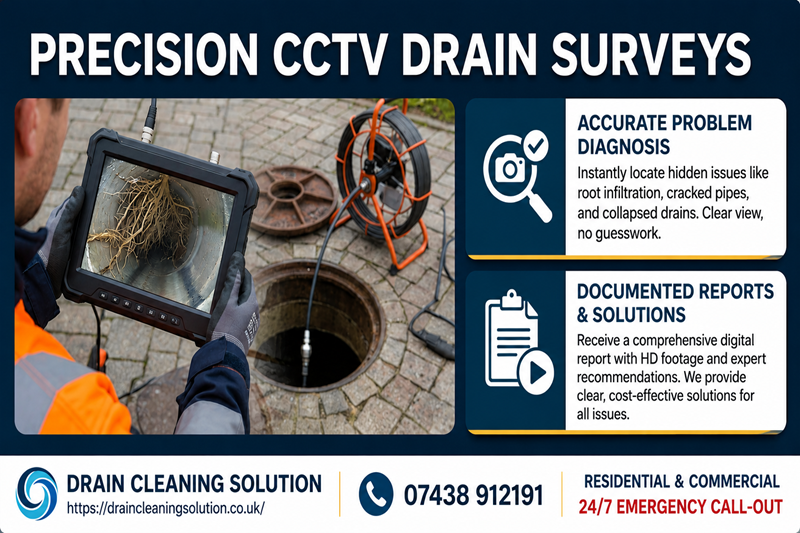
A CCTV drain survey before buying a house in South London is a non-invasive inspection of the property’s drainage system using a high-definition waterproof camera. The camera is fed through the drain access points — inspection chambers, manholes, or rodding eyes — and transmits live footage to the engineer’s screen above ground.
The entire survey is non-destructive. Nothing is dug up. The garden, driveway, and paving are completely undisturbed. In most cases, a full residential survey takes between 45 minutes and 90 minutes.
At the end of the survey, you receive a full written report documenting every observation made during the inspection: the location of any defects (mapped against the pipe run), photographic evidence from the footage, a grading of defect severity, and a recommended course of action. You also receive the recorded footage to keep.
How the Survey Changes Your Position as a Buyer
The most important benefit of a pre-purchase drain survey is not finding that everything is fine — it is finding out when things are not, before you are legally committed.
If the survey identifies significant drainage defects — a collapsed section beneath the driveway, root intrusion throughout the rear garden drain run, a cracked main connection near the property boundary — you have concrete, documented evidence to use in renegotiation. You can request that the vendor commissions and pays for the necessary repairs before exchange, or you can negotiate a reduction in the purchase price that reflects the cost of the required work. Either outcome is significantly better than discovering the same problems after completion.
Solicitors increasingly recognise the value of drain survey evidence during conveyancing. Some mortgage lenders are also beginning to request drainage information for older properties in higher-risk areas. A clean drain survey report provides positive assurance that the property’s drainage system is in serviceable condition — useful both during the transaction and as part of your property records going forward.
| Practical note: The cost of a pre-purchase CCTV drain survey is modest relative to the value of the property transaction and the potential cost of the defects it might find. A single collapsed drain section requiring excavation and pipe replacement can easily cost several thousand pounds. Root intrusion requiring pipe relining across a substantial section of drain run can cost more. The survey cost is a small premium for the certainty it provides. |
What Happens if the Survey Finds Problems?
Not every defect found in a pre-purchase survey is a deal-breaker. Minor issues — hairline cracks, partial root intrusion, some displacement at joints — may be assessed as manageable and repairable at reasonable cost. The written report gives you a professional assessment of severity, and the footage gives you something concrete to discuss with the vendor and your solicitor.
For more serious findings — a full pipe collapse, extensive root invasion across multiple drain runs, evidence of leaking waste causing ground saturation — you are in a much stronger position knowing before exchange than after completion. The survey gives you choices; proceeding without one removes them.
When to Commission the Survey in the Buying Process
The optimal point to commission a pre-purchase drain survey is after you have had an offer accepted and instructed a solicitor, but before you exchange contracts. This gives you time to receive the survey report, take legal advice on any findings, and — if necessary — renegotiate with the vendor without the pressure of an imminent exchange date.
In practice, a survey can usually be arranged and completed within a week of booking. Specialist drainage companies with local South London coverage can typically turn around the written report within 24 to 48 hours of the inspection.
A Final Word for Buyers in Croydon and South London
The drainage systems beneath South London’s properties carry decades of history. Some will be in excellent condition; many will not be. The only way to know which category you are buying into is to look — and that means commissioning a professional survey that your standard valuation or building survey simply cannot replicate.
For anyone purchasing in Croydon, Sutton, Bromley, Purley, Mitcham, or the wider South London area, a specialist drain survey company in Croydon can give you the same professional assessment of the drainage system that a structural engineer gives you of the building above ground. In a market where unexpected repair costs can run into the thousands, it is one of the smartest investments a property buyer can make.